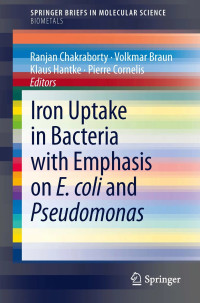
Electronic Resource
Iron uptake in bacteria with emphasis on e. coli and pseudomonas
Iron is essential for the growth of most bacteria because it serves as a cofactor for vital enzymes and for the components of the electron transport chain. Moreover, Iron plays an important role in bacterial pathogenicity; in fact, the iron transport systems in bacteria works as target for designing novel antibiotics. Because iron is not soluble under aerobic conditions, bacteria have had to find ways to overcome iron deficiency. One of them is producing an iron-chelating small organic molecule called siderophore. Indeed, most bacteria and fungi produce structurally and chemically diverse siderophores which are transported back to the cytoplasm using complex energy dependent transport systems. Escherichia coli and Pseudomonas were the first ones to be tested; however, nowadays iron transport systems have been investigated in many other bacteria.
Iron Uptake in Bacteria with Emphasis on E. coli and Pseudomonas reviews the recent advancements in the field of iron transport systems in bacteria. Chapter 1 is dedicated to Dr. Dick van der Helm’s contribution to the field of siderophore biology. It then describes and discusses the structural advances in the components and the mechanism of siderophore mediated iron transport systems in E.coli. Chapter 2 details the variety of iron transport and iron regulatory systems of both gram negative and gram positive bacteria. Finally, chapter 3 describes the iron transport systems of Pseudomonas.
This book is aimed at researchers in the fields of iron metabolism in multiple organisms, and to those who are interested in studying iron transport systems of bacteria. It appeals also to scientists researching structure and function relationship of proteins.
Zat besi sangat penting bagi pertumbuhan sebagian besar bakteri karena berfungsi sebagai kofaktor bagi enzim vital dan bagi komponen rantai transpor elektron. Selain itu, zat besi berperan penting dalam patogenisitas bakteri; faktanya, sistem transpor zat besi pada bakteri berfungsi sebagai target untuk merancang antibiotik baru. Karena zat besi tidak larut dalam kondisi aerobik, bakteri harus menemukan cara untuk mengatasi kekurangan zat besi. Salah satunya adalah dengan memproduksi molekul organik kecil pengkelat zat besi yang disebut siderofor. Memang, sebagian besar bakteri dan jamur menghasilkan siderofor yang beragam secara struktural dan kimiawi yang diangkut kembali ke sitoplasma menggunakan sistem transpor kompleks yang bergantung pada energi. Escherichia coli dan Pseudomonas adalah yang pertama diuji; namun, saat ini sistem transpor zat besi telah diselidiki pada banyak bakteri lainnya.
Penyerapan Zat Besi pada Bakteri dengan Penekanan pada E. coli dan Pseudomonas mengulas kemajuan terkini di bidang sistem transpor zat besi pada bakteri. Bab 1 didedikasikan untuk kontribusi Dr. Dick van der Helm pada bidang biologi siderofor. Kemudian, buku ini menjelaskan dan membahas kemajuan struktural dalam komponen dan mekanisme sistem transpor zat besi yang dimediasi siderofor dalam E.coli. Bab 2 merinci berbagai sistem transpor zat besi dan pengaturan zat besi pada bakteri gram negatif dan gram positif. Terakhir, bab 3 menjelaskan sistem transpor zat besi pada Pseudomonas.
Buku ini ditujukan untuk para peneliti di bidang metabolisme zat besi dalam berbagai organisme, dan bagi mereka yang tertarik mempelajari sistem transpor zat besi pada bakteri. Buku ini juga menarik bagi para ilmuwan yang meneliti hubungan struktur dan fungsi protein.
Ketersediaan
Informasi Detail
- Judul Seri
-
Springerbriefs in molecular science
- No. Panggil
-
E393
- Penerbit
- Dordrecht, Holland : Springer Dordrecht., 2013
- Deskripsi Fisik
-
XI, 89 Hlm.
- Bahasa
-
English
- ISBN/ISSN
-
9789400760882
- Klasifikasi
-
NONE
- Tipe Isi
-
text
- Tipe Media
-
computer
- Tipe Pembawa
-
online resource
- Edisi
-
1
- Subjek
- Info Detail Spesifik
-
-
- Pernyataan Tanggungjawab
-
Ranjan Chakraborty, Volkmar Braun, Klaus Hantke, Pierre Cornelis
Versi lain/terkait
Tidak tersedia versi lain
Lampiran Berkas
Komentar
Anda harus masuk sebelum memberikan komentar
 Karya Umum
  Filsafat
  Agama
Agama  Ilmu-ilmu Sosial
  Bahasa
  Ilmu-ilmu Murni
  Ilmu-ilmu Terapan
  Kesenian, Hiburan, dan Olahraga
  Kesusastraan
  Geografi dan Sejarah