Ditapis dengan

Matematika : program peningkatan kualifikasi guru madrasah dan guru pendidika…
Bibliografi : hlm. 357 No Inv.: 144147-144148/S/Perp/14/2c
- Edisi
- -
- ISBN/ISSN
- -
- Deskripsi Fisik
- vi, 361 hlm.
- Judul Seri
- -
- No. Panggil
- 510 PUR m
Basic category theory
No Inv.: 146727, 146728/P/Perp/14/2c
- Edisi
- -
- ISBN/ISSN
- 9781107044241
- Deskripsi Fisik
- viii, 183 hlm.
- Judul Seri
- -
- No. Panggil
- 510.1 LEI b
Principles of computational fluid dynamics : with 150 figures
Bibliografi : hlm. 603-632 No Inv.: 146587/P/Perp/14/1c
- Edisi
- -
- ISBN/ISSN
- 9783642051456
- Deskripsi Fisik
- xii, 644 hlm.
- Judul Seri
- -
- No. Panggil
- 511.352 WES p

Evolution equations arising in the modelling of life sciences
This book deals with the modeling, analysis and simulation of problems arising in the life sciences, and especially in biological processes. The models and findings presented result from intensive discussions with microbiologists, doctors and medical staff, physicists, chemists and industrial engineers and are based on experimental data. They lead to a new class of degenerate density-dependent …
- Edisi
- Ed.1
- ISBN/ISSN
- 9783034806152
- Deskripsi Fisik
- xii, 217 hlm.
- Judul Seri
- -
- No. Panggil
- E686
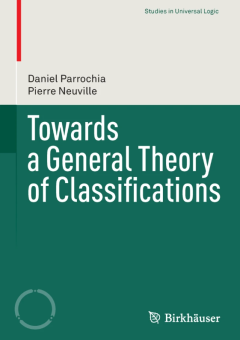
Towards a general theory of classifications
This book is an essay on the epistemology of classifications. Its main purpose is not to provide an exposition of an actual mathematical theory of classifications, that is, a general theory which would be available to any kind of them: hierarchical or non-hierarchical, ordinary or fuzzy, overlapping or non-overlapping, finite or infinite, and so on, establishing a basis for all possible divisio…
- Edisi
- Ed.1
- ISBN/ISSN
- 9783034806091
- Deskripsi Fisik
- xxiii, 304 hlm.
- Judul Seri
- -
- No. Panggil
- E685

Visual reasoning with diagrams
Logic, the discipline that explores valid reasoning, does not need to be limited to a specific form of representation but should include any form as long as it allows us to draw sound conclusions from given information. The use of diagrams has a long but unequal history in logic: The golden age of diagrammatic logic of the 19th century thanks to Euler and Venn diagrams was followed by the early…
- Edisi
- Ed.1
- ISBN/ISSN
- 9783034806008
- Deskripsi Fisik
- xv, 200 hlm.
- Judul Seri
- -
- No. Panggil
- E683

Problem-solving methods in combinatorics : an approach to olympiad problems
Every year there is at least one combinatorics problem in each of the major international mathematical olympiads. These problems can only be solved with a very high level of wit and creativity. This book explains all the problem-solving techniques necessary to tackle these problems, with clear examples from recent contests. It also includes a large problem section for each topic, including hin…
- Edisi
- Ed.1
- ISBN/ISSN
- 9783034805971
- Deskripsi Fisik
- ix, 174 hlm.
- Judul Seri
- -
- No. Panggil
- E682
Matematika ekonomi 1
Bibliografi disetiap bab No Inv.: 144490/SM/Perp/14/1c
- Edisi
- cet. ke-17
- ISBN/ISSN
- 9796896052
- Deskripsi Fisik
- 407 hlm.
- Judul Seri
- -
- No. Panggil
- 330.015 1 WID m

Advances in harmonic analysis and operator theory : the Stefan Samko annivers…
This volume is dedicated to Professor Stefan Samko on the occasion of his seventieth birthday. The contributions display the range of his scientific interests in harmonic analysis and operator theory. Particular attention is paid to fractional integrals and derivatives, singular, hypersingular and potential operators in variable exponent spaces, pseudodifferential operators in various modern fu…
- Edisi
- -
- ISBN/ISSN
- 9783034805162
- Deskripsi Fisik
- viii, 392
- Judul Seri
- -
- No. Panggil
- E669

Variable lebesgue spaces : foundations and harmonic analysis
This book provides an accessible introduction to the theory of variable Lebesgue spaces. These spaces generalize the classical Lebesgue spaces by replacing the constant exponent p with a variable exponent p(x). They were introduced in the early 1930s but have become the focus of renewed interest since the early 1990s because of their connection with the calculus of variations and partial differ…
- Edisi
- Ed.1
- ISBN/ISSN
- 9783034805483
- Deskripsi Fisik
- ix, 312 hlm.
- Judul Seri
- -
- No. Panggil
- E676
 Karya Umum
  Filsafat
  Agama
Agama  Ilmu-ilmu Sosial
  Bahasa
  Ilmu-ilmu Murni
  Ilmu-ilmu Terapan
  Kesenian, Hiburan, dan Olahraga
  Kesusastraan
  Geografi dan Sejarah