Ditapis dengan

Planets, stars, and galaxies
No Inv.: 1898-1899/BD/Perp/87/2c
- Edisi
- 4th ed
- ISBN/ISSN
- -
- Deskripsi Fisik
- x, 336 hlm.
- Judul Seri
- -
- No. Panggil
- 520 ING p
Astronomy the structure of the universe
No Inv.: 1404-1405/Perp/85/2c
- Edisi
- -
- ISBN/ISSN
- -
- Deskripsi Fisik
- xi, 491 hlm.
- Judul Seri
- -
- No. Panggil
- 520 KAU a

Moon bound : choosing and preparing NASA's lunar astronauts
Often lost in the shadow of the first group of astronauts for the Mercury missions, the second and third groups included the leading figures for NASA's activities for the following two decades. “Moon Bound” complements the author’s recently published work, “Selecting the Mercury Seven” (2011), extending the story of the men who helped to launch human spaceflight and broaden the Americ…
- Edisi
- -
- ISBN/ISSN
- 9781461438557
- Deskripsi Fisik
- xxviii, 371 hlm. : il.
- Judul Seri
- Springer Praxis Books (PRAXIS)
- No. Panggil
- E1559

Astrophysics of the interstellar medium
The space between the stars contains a large diversity of objects in which physical processes occur that are fundamental to the structure and evolution of galaxies. This book offers the reader a basic knowledge of these processes and presents simple numeric estimates of the main quantities relevant to the interstellar medium. The main objects that constitute the interstellar space are described…
- Edisi
- -
- ISBN/ISSN
- 9781461437673
- Deskripsi Fisik
- xvi, 258 hlm.
- Judul Seri
- -
- No. Panggil
- E1558

Laboratory experiments in Physics for modern Astronomy : with comprehensive d…
This book presents experiments which will teach physics relevant to astronomy. The astronomer, as instructor, frequently faces this need when his college or university has no astronomy department and any astronomy course is taught in the physics department. The physicist, as instructor, will find this intellectually appealing when faced with teaching an introductory astronomy course. From these…
- Edisi
- -
- ISBN/ISSN
- 9781461433118
- Deskripsi Fisik
- xxx, 570 hlm.
- Judul Seri
- -
- No. Panggil
- E1557

The Science of solar system ices
The role of laboratory research and simulations in advancing our understanding of solar system ices (including satellites, KBOs, comets, and giant planets) is becoming increasingly important. Understanding ice surface radiation processing, particle and radiation penetration depths, surface and subsurface chemistry, morphology, phases, density, conductivity, etc., are only a few examples of the …
- Edisi
- -
- ISBN/ISSN
- 9781461430766
- Deskripsi Fisik
- xiv, 658 hlm.
- Judul Seri
- Astrophysics and Space Science Library (ASSL, volume 356)
- No. Panggil
- E1556

An Introduction to the evolution of single and binary stars
An Introduction to the Evolution of Single and Binary Stars provides physicists with an understanding of binary and single star evolution, beginning with a background and introduction of basic astronomical concepts. Although a general treatment of stellar structure and evolution is included, the text stresses the physical processes that lead to stellar mass compact object binaries that may be s…
- Edisi
- -
- ISBN/ISSN
- 9781441999917
- Deskripsi Fisik
- xii, 262 hlm. : il. warna.
- Judul Seri
- Undergraduate Lecture Notes in Physics (ULNP)
- No. Panggil
- E1551
Ask me a question abaut rockets, satellites and space stations
No Inv.: 104/AF/Perp/96/1c
- Edisi
- -
- ISBN/ISSN
- -
- Deskripsi Fisik
- 95 hlm.
- Judul Seri
- -
- No. Panggil
- 520 ROS a
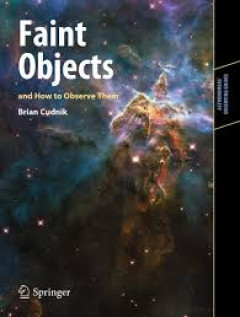
Faint objects and how to observe them
Faint Objects and How to Observe Them is for visual observers who are equipped with a 10-inch or larger astronomical telescope and who want to "go deep" with their observing. It provides a guide to some of the most distant, dim, and rarely observed objects in the sky, supported by background information on surveys and objects lists - some familiar, such as Caldwell, and some not so familiar. Th…
- Edisi
- -
- ISBN/ISSN
- 9781441967572
- Deskripsi Fisik
- xii, 241 hlm. : il. warna.
- Judul Seri
- Astronomers' Observing Guides (OBSERVING)
- No. Panggil
- E1545
Perjalanan mengenal astronomi
No Inv.: 472-476/P/Perp/99/5c
- Edisi
- -
- ISBN/ISSN
- 9798591321
- Deskripsi Fisik
- 90 hlm.
- Judul Seri
- -
- No. Panggil
- 520.02 PER
 Karya Umum
  Filsafat
  Agama
Agama  Ilmu-ilmu Sosial
  Bahasa
  Ilmu-ilmu Murni
  Ilmu-ilmu Terapan
  Kesenian, Hiburan, dan Olahraga
  Kesusastraan
  Geografi dan Sejarah