Ditapis dengan

Teori mikroekonomi
No Inv.: 64180-64189/P/00/10c
- Edisi
- -
- ISBN/ISSN
- -
- Deskripsi Fisik
- x, 374 hlm.
- Judul Seri
- -
- No. Panggil
- 338.5 BIL t
Pengantar mikrobiologi umum
No Inv.: 66515-66524/P/00/10c
- Edisi
- -
- ISBN/ISSN
- -
- Deskripsi Fisik
- x, 259 hlm.
- Judul Seri
- -
- No. Panggil
- 576.1 RIS p
The M68HC11 microcontroller : applications in control, instrumentation and co…
No Inv.: 67548/P/00/1c
- Edisi
- -
- ISBN/ISSN
- 013852181
- Deskripsi Fisik
- xi, 399 hlm.
- Judul Seri
- -
- No. Panggil
- 004.16 KHE m
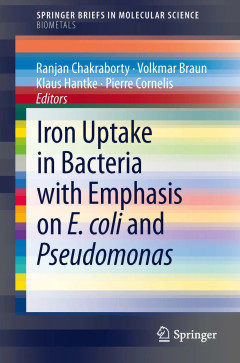
Iron uptake in bacteria with emphasis on e. coli and pseudomonas
Iron is essential for the growth of most bacteria because it serves as a cofactor for vital enzymes and for the components of the electron transport chain. Moreover, Iron plays an important role in bacterial pathogenicity; in fact, the iron transport systems in bacteria works as target for designing novel antibiotics. Because iron is not soluble under aerobic conditions, bacteria have had to fi…
- Edisi
- 1
- ISBN/ISSN
- 9789400760882
- Deskripsi Fisik
- XI, 89 Hlm.
- Judul Seri
- Springerbriefs in molecular science
- No. Panggil
- E393

Thermophilic microbes in environmental and industrial biotechnology: biotechn…
The existence of life at high temperatures is quiet fascinating. At elevated temperatures, only microorganisms are capable of growth and survival. Many thermophilic microbial genera have been isolated from man-made (washing machines, factory effluents, waste streams and acid mine effluents) and natural (volcanic areas, geothermal areas, terrestrial hot springs, submarine hydrothermal vents, geo…
- Edisi
- 2
- ISBN/ISSN
- 9789400758995
- Deskripsi Fisik
- XX, 954 Hlm.
- Judul Seri
- -
- No. Panggil
- E390
Intelligent hydrogels
This volume of Progress in Colloid and Polymer Science assembles original contributions and invited reviews from the priority research program "Intelligent Hydrogels", funded by the German Science Foundation DFG since 2006, with about 25 contributing research groups. In the center of interest of this program and the present book are responsive hydrogels, i.e. hydrophilic polymer or polyelectrol…
- Edisi
- -
- ISBN/ISSN
- 9783319016832
- Deskripsi Fisik
- VIII, 279 lembar : il. warna
- Judul Seri
- Progress in Colloid and Polymer Science
- No. Panggil
- E225
Bertani jamur dan seni memasaknya
No Inv.: 71938-71939/S/01/2c
- Edisi
- -
- ISBN/ISSN
- 9794046922
- Deskripsi Fisik
- vi, 77 hlm.
- Judul Seri
- -
- No. Panggil
- 579.5 NUR b
Ekonomi mikro : pendekatan kontemporer
No Inv.: 80588-80594/P/02/2c~100304-100307/P/Perp/05/4c
- Edisi
- ed ke-1
- ISBN/ISSN
- 979691025X
- Deskripsi Fisik
- xxviii, 501 hlm.
- Judul Seri
- -
- No. Panggil
- 338.5 MAC e
Panduan pengajar buku pengantar mikrobiologi
No Inv.: 82212-82214/S/02/3c
- Edisi
- -
- ISBN/ISSN
- -
- Deskripsi Fisik
- v, 89 hlm.
- Judul Seri
- -
- No. Panggil
- 576.07 TAR p

Micro and nanofabrication using self-assembled Biological nanostructures
Self-assembled nanostructures based on peptides and proteins have been investigated and presented as biomaterials with an impressive potential for a broad range of applications such as microfabrication, biosensing platforms, drug delivery systems, bioelectronics and tissue reparation. Through self-assembly peptides can give rise to a range of well-defined nanostructures such as nanotubes, nanof…
- Edisi
- -
- ISBN/ISSN
- 9780323296427
- Deskripsi Fisik
- ix, 115 hlm.
- Judul Seri
- Micro and Nano Technologies
- No. Panggil
- E1479
 Karya Umum
 Filsafat
 Agama
 Ilmu-ilmu Sosial
 Bahasa
 Ilmu-ilmu Murni
 Ilmu-ilmu Terapan
 Kesenian, Hiburan, dan Olahraga
 Kesusastraan
 Geografi dan Sejarah