Ditapis dengan

Laboratory experiments in Physics for modern Astronomy : with comprehensive d…
This book presents experiments which will teach physics relevant to astronomy. The astronomer, as instructor, frequently faces this need when his college or university has no astronomy department and any astronomy course is taught in the physics department. The physicist, as instructor, will find this intellectually appealing when faced with teaching an introductory astronomy course. From these…
- Edisi
- -
- ISBN/ISSN
- 9781461433118
- Deskripsi Fisik
- xxx, 570 hlm.
- Judul Seri
- -
- No. Panggil
- E1557

Materi pokok pengantar mekanika kuantum; 1-6; PFIS 4437/2 SKS
No Inv.: 1581-1590/P/Perp/97/10c
- Edisi
- Cet. ke-2
- ISBN/ISSN
- -
- Deskripsi Fisik
- iv, 215 hlm.
- Judul Seri
- -
- No. Panggil
- 530.12 BAI m

The Science of solar system ices
The role of laboratory research and simulations in advancing our understanding of solar system ices (including satellites, KBOs, comets, and giant planets) is becoming increasingly important. Understanding ice surface radiation processing, particle and radiation penetration depths, surface and subsurface chemistry, morphology, phases, density, conductivity, etc., are only a few examples of the …
- Edisi
- -
- ISBN/ISSN
- 9781461430766
- Deskripsi Fisik
- xiv, 658 hlm.
- Judul Seri
- Astrophysics and Space Science Library (ASSL, volume 356)
- No. Panggil
- E1556
Buku materi pokok pengetahuan nuklir; 1-5; PIPA 4432/3 SKS
No Inv.: 343-347/P/Perp/97/5c
- Edisi
- -
- ISBN/ISSN
- -
- Deskripsi Fisik
- v, 219 hlm.
- Judul Seri
- -
- No. Panggil
- 539.7 JAT b
Physics : for scientists and engineers
No Inv.: 734/P/Perp/97/1c
- Edisi
- 2nd ed
- ISBN/ISSN
- 0673520412
- Deskripsi Fisik
- xxxii, 1114 hlm.
- Judul Seri
- -
- No. Panggil
- 530 WOL p
Buku materi pokok kimia; 1-9; KIMA 4310/3 SKS
No Inv.: 2197-2216/P/Perp/97/20c
- Edisi
- -
- ISBN/ISSN
- -
- Deskripsi Fisik
- 2 jld.
- Judul Seri
- -
- No. Panggil
- 541 YAH b
Materi pokok fisika II; 1-9; FISA 4111/3 SKS
No Inv.: 1319-1328/P/Perp/97/10c
- Edisi
- -
- ISBN/ISSN
- -
- Deskripsi Fisik
- iv, 207 hlm.
- Judul Seri
- -
- No. Panggil
- 530 MAT
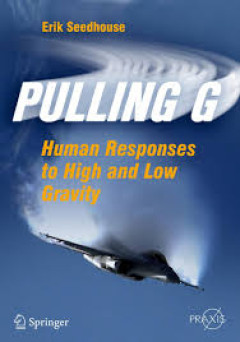
Pulling g : human responses to high and low gravity
Performing in a high G environment is extremely demanding on the body: pulling G forces blood to the body’s extremities, putting the pilot, astronaut or driver at risk of G-Induced Lack of Consciousness (G-LOC). In “Pulling G” Erik Seedhouse describes what it feels like to pull 7 G in a fighter plane and the G pressures on the body when driving a Formula 1 car and many other gravity-defyi…
- Edisi
- -
- ISBN/ISSN
- 9781461430308
- Deskripsi Fisik
- xxvi, 210 hlm. : il. warna.
- Judul Seri
- Springer Praxis Books (PRAXIS)
- No. Panggil
- E1554
Materi pokok pengetahuan nuklir; 1-9; PIPA 4432/3 SKS
No Inv.: 338-342/P/Perp/97/5c
- Edisi
- -
- ISBN/ISSN
- -
- Deskripsi Fisik
- vi, 388 hlm.
- Judul Seri
- -
- No. Panggil
- 539.7 MAT
Buku materi pokok fisika I ; 6-9; PIPA 2231/3 SKS
No Inv.: 3297-3306/P/Perp/97/10c
- Edisi
- -
- ISBN/ISSN
- -
- Deskripsi Fisik
- iv, 116 hlm.
- Judul Seri
- -
- No. Panggil
- 530 BUK
 Karya Umum
 Filsafat
 Agama
 Ilmu-ilmu Sosial
 Bahasa
 Ilmu-ilmu Murni
 Ilmu-ilmu Terapan
 Kesenian, Hiburan, dan Olahraga
 Kesusastraan
 Geografi dan Sejarah