Ditapis dengan

Ultra-short pulsed laser engineered metal-glass nanocomposites
Glasses containing metallic nanoparticles exhibit very promising linear and nonlinear optical properties, mainly due to the surface plasmon resonances (SPRs) of the nanoparticles. The spectral position in the visible and near-infrared range and polarization dependence of the SPR are characteristically determined by the nanoparticles’ shapes. The focus of Ultra-Short Pulsed Laser Engineered…
- Edisi
- -
- ISBN/ISSN
- 9783319004372
- Deskripsi Fisik
- xii, 76 hlm. : iil. warna.
- Judul Seri
- SpringerBriefs in Physics
- No. Panggil
- E1650
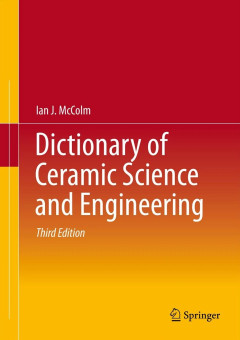
Dictionary of ceramic science and engineering
The third edition of the Dictionary of Ceramic Science and Engineering builds on the heavily revised 2nd edition which, in turn, expanded the original edition by some 4000 entries to include new fabrication, testing, materials, and vocabulary. The proven basis of the first two editions has been retained but new words and phrases have been added from the rapidly advancing electronic, nanopar…
- Edisi
- 3
- ISBN/ISSN
- 9789400709164
- Deskripsi Fisik
- X, 549 Hlm.
- Judul Seri
- -
- No. Panggil
- E380
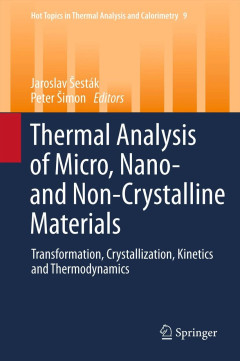
Thermal analysis of micro, nano- and non-crystalline materials
Thermal Analysis of Micro-, Nano- and Non-Crystalline Materials: Transformation, Crystallization, Kinetics, and Thermodynamics complements and adds to volume 8 Glassy, Amorphous and Nano-Crystalline Materials by providing a coherent and authoritative overview of cutting-edge themes in this field. In particular, the book focuses on reaction thermodynamics and kinetics applied to solid-state chem…
- Edisi
- 1
- ISBN/ISSN
- 9789048131501
- Deskripsi Fisik
- XXII, 486
- Judul Seri
- Hot topics in thermal analysis and calorimetry
- No. Panggil
- E377

Reinforced polymer matrix syntactic foams : effect of nano and micro-scale re…
Reinforced Syntactic Foams: Effect of Nano and Micro-Scale Reinforcement examines the fabrication processes, mechanism of reinforcement, and structure-property correlations of reinforced syntactic foams. The authors present the state of the art in this field, compare the properties of various types of syntactic foam systems comprising different matrix, hollow particle, and reinforcement materia…
- Edisi
- -
- ISBN/ISSN
- 9783319012438
- Deskripsi Fisik
- X, 80 lembar : il. warna
- Judul Seri
- SpringerBriefs in Materials
- No. Panggil
- E216
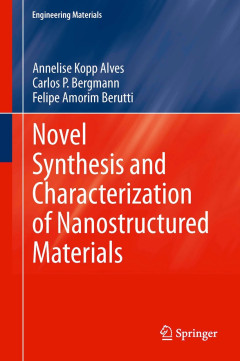
Novel synthesis and characterization of nanostructured materials
Nanostructured materials have been largely studied in the last few years. They have great potential of applications in different fields such as materials science, physics, chemistry, biology, mechanic and medicine. Synthesis and characterization of nanostructured materials is a subject of great interest involving science, market, politicians, government and society. Based on results obtained by…
- Edisi
- 1
- ISBN/ISSN
- 9783642412752
- Deskripsi Fisik
- IX, 85 Hlm.
- Judul Seri
- Engineering materials
- No. Panggil
- E353
Handbook of gas sensor materials : properties, advantages and shortcomings fo…
The two volumes of Handbook of Gas Sensor Materials provide a detailed and comprehensive account of materials for gas sensors, including the properties and relative advantages of various materials. Since these sensors can be applied for the automation of myriad industrial processes, as well as for everyday monitoring of such activities as public safety, engine performance, medical therapeutics…
- Edisi
- -
- ISBN/ISSN
- 9781461471653
- Deskripsi Fisik
- XIX, 442 lembar : il. warna
- Judul Seri
- -
- No. Panggil
- E170
Ceramic materials : science and engineering
Ceramic Materials: Science and Engineering is an up-to-date treatment of ceramic science, engineering, and applications in a single, comprehensive text. Building on a foundation of crystal structures, phase equilibria, defects, and the mechanical properties of ceramic materials, students are shown how these materials are processed for a wide diversity of applications in today's society. Concept…
- Edisi
- Second Edition
- ISBN/ISSN
- 9781461435235
- Deskripsi Fisik
- XXXIII, 766 hlm.
- Judul Seri
- -
- No. Panggil
- E141
Material dan nanokomposit
Bibliografi : hlm. 189-199
- Edisi
- -
- ISBN/ISSN
- 9786230119552
- Deskripsi Fisik
- x, 203 hlm. : il. ; 23 cm.
- Judul Seri
- -
- No. Panggil
- 620.118 RIH m
 Karya Umum
  Filsafat
  Agama
Agama  Ilmu-ilmu Sosial
  Bahasa
  Ilmu-ilmu Murni
  Ilmu-ilmu Terapan
  Kesenian, Hiburan, dan Olahraga
  Kesusastraan
  Geografi dan Sejarah