Ditapis dengan
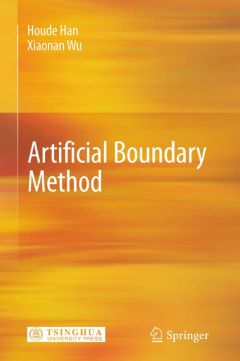
Artificial boundary method
"Artificial Boundary Method" systematically introduces the artificial boundary method for the numerical solutions of partial differential equations in unbounded domains. Detailed discussions treat different types of problems, including Laplace, Helmholtz, heat, Schrödinger, and Navier and Stokes equations. Both numerical methods and error analysis are discussed. The book is intended for resear…
- Edisi
- -
- ISBN/ISSN
- 9783642354649
- Deskripsi Fisik
- viii, 423 hlm.
- Judul Seri
- -
- No. Panggil
- E809

Domain decomposition methods in science and engineering xx
These are the proceedings of the 20th international conference on domain decomposition methods in science and engineering. Domain decomposition methods are iterative methods for solving the often very large linearor nonlinear systems of algebraic equations that arise when various problems in continuum mechanics are discretized using finite elements. They are designed for massively parallel comp…
- Edisi
- Ed.1
- ISBN/ISSN
- 9783642352751
- Deskripsi Fisik
- xix, 686 hlm.
- Judul Seri
- -
- No. Panggil
- E804

Sparse grids and applications
In the recent decade, there has been a growing interest in the numerical treatment of high-dimensional problems. It is well known that classical numerical discretization schemes fail in more than three or four dimensions due to the curse of dimensionality. The technique of sparse grids helps overcome this problem to some extent under suitable regularity assumptions. This discretization approach…
- Edisi
- -
- ISBN/ISSN
- 9783642317033
- Deskripsi Fisik
- x, 286 hlm.
- Judul Seri
- -
- No. Panggil
- E760

Modeling in computational biology and biomedicine
Computational biology, mathematical biology, biology and biomedicine are currently undergoing spectacular progresses due to a synergy between technological advances and inputs from physics, chemistry, mathematics, statistics and computer science. The goal of this book is to evidence this synergy by describing selected developments in the following fields: bioinformatics, biomedicine and neurosc…
- Edisi
- -
- ISBN/ISSN
- 9783642312083
- Deskripsi Fisik
- xxvi, 318 hlm.
- Judul Seri
- -
- No. Panggil
- E758

Uncertainty quantification in computational fluid dynamics
Fluid flows are characterized by uncertain inputs such as random initial data, material and flux coefficients, and boundary conditions. The current volume addresses the pertinent issue of efficiently computing the flow uncertainty, given this initial randomness. It collects seven original review articles that cover improved versions of the Monte Carlo method (the so-called multi-level Monte Car…
- Edisi
- Ed.1
- ISBN/ISSN
- 9783319008851
- Deskripsi Fisik
- ix, 333
- Judul Seri
- -
- No. Panggil
- E713

Ricci flow for shape analysis and surface registration : theories, algorithms…
Ricci Flow for Shape Analysis and Surface Registration introduces the beautiful and profound Ricci flow theory in a discrete setting. By using basic tools in linear algebra and multivariate calculus, readers can deduce all the major theorems in surface Ricci flow by themselves. The authors adapt the Ricci flow theory to practical computational algorithms, apply Ricci flow for shape analys…
- Edisi
- -
- ISBN/ISSN
- 9781461487814
- Deskripsi Fisik
- xi, 139
- Judul Seri
- -
- No. Panggil
- E647

A Graduate Introduction to Numerical Methods : From the Viewpoint of Backward…
This book provides an extensive introduction to numerical computing from the viewpoint of backward error analysis. The intended audience includes students and researchers in science, engineering and mathematics. The approach taken is somewhat informal owing to the wide variety of backgrounds of the readers, but the central ideas of backward error and sensitivity (conditioning) are systematicall…
- Edisi
- -
- ISBN/ISSN
- 9781461484530
- Deskripsi Fisik
- XXXIX, 869 hlm.
- Judul Seri
- -
- No. Panggil
- E633

People, problems, and proofs
People, problems, and proofs are the lifeblood of theoretical computer science. Behind the computing devices and applications that have transformed our lives are clever algorithms, and for every worthwhile algorithm there is a problem that it solves and a proof that it works. Before this proof there was an open problem: can one create an efficient algorithm to solve the computational problem? A…
- Edisi
- -
- ISBN/ISSN
- 9783642414220
- Deskripsi Fisik
- xviii, 333
- Judul Seri
- -
- No. Panggil
- E1321
 Karya Umum
 Filsafat
 Agama
 Ilmu-ilmu Sosial
 Bahasa
 Ilmu-ilmu Murni
 Ilmu-ilmu Terapan
 Kesenian, Hiburan, dan Olahraga
 Kesusastraan
 Geografi dan Sejarah