Ditapis dengan

Formation of the solar system : a new theory of the creation and decay of the…
Analysis of the orbital motion of the Earth, the Moon and other planets and their satellites led to the discovery that all bodies in the Solar System are moving with the first cosmic velocity of their proto parents. The mean orbital velocity of each planet is equal to the first cosmic velocity of the Protosun, the radius of which is equal to the semi-major axis of the planet’s orbit. The same…
- Edisi
- -
- ISBN/ISSN
- 978-94-007-5908-4
- Deskripsi Fisik
- xii, 305 hlm. : il. warna.
- Judul Seri
- -
- No. Panggil
- E1840

Planets, stars and stellar systems ; Volume 3: Solar and stellar planetary sy…
This is volume 3 of Planets, Stars and Stellar Systems, a six-volume compendium of modern astronomical research covering subjects of key interest to the main fields of contemporary astronomy. This volume on “Solar and Stellar Planetary Systems” edited by Linda French and Paul Kalas presents accessible review chapters From Disks to Planets, Dynamical Evolution of Planetary Systems, The Terre…
- Edisi
- -
- ISBN/ISSN
- 9789400756069
- Deskripsi Fisik
- xvi, 545 hlm. : il. warna.
- Judul Seri
- -
- No. Panggil
- E1832

In quest of the solar system
No. Inv. : 146098-146099/P/Perp/15/2c
- Edisi
- -
- ISBN/ISSN
- 9780763766290
- Deskripsi Fisik
- xix, 612 hlm. : il. ; 28 cm.
- Judul Seri
- -
- No. Panggil
- 523.2 KOU i

Moving heaven and earth : Copernicus and solar system
- Edisi
- -
- ISBN/ISSN
- 9781785782695
- Deskripsi Fisik
- vi, 158 hlm. : il. ; 20 cm.
- Judul Seri
- -
- No. Panggil
- 520.9 HEN m
- Edisi
- -
- ISBN/ISSN
- 9781785782695
- Deskripsi Fisik
- vi, 158 hlm. : il. ; 20 cm.
- Judul Seri
- -
- No. Panggil
- 520.9 HEN m
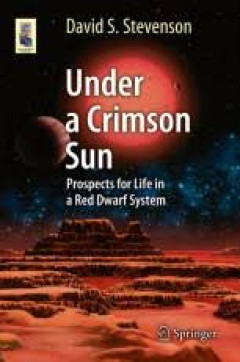
Under a crimson sun : prospects for life in a Red Dwarf System
Gliese 581 is a red dwarf star some 20.3 light years from Earth. Red dwarfs are among the most numerous stars in the galaxy, and they sport diverse planetary systems. At magnitude 10, Gliese 581 is visible to amateur observers but does not stand out. So what makes this star so important? It is that professional observers have confirmed that it has at least four planets orbiting it, and in 2009,…
- Edisi
- -
- ISBN/ISSN
- 9781461481331
- Deskripsi Fisik
- XIV, 324 hlm. : Il. warna.
- Judul Seri
- Astronomers' Universe
- No. Panggil
- E1631

The Constellation observing atlas
Designed for anyone who wishes to learn the constellations or observe the best and brightest deep sky objects and double stars, this book contains an alphabetical list of constellations complete with star maps, historical background, and highlights of deep sky objects. Each entry contains position and physical information on enough stars to support astronomers in star-hopping, swinging the tele…
- Edisi
- -
- ISBN/ISSN
- 978-1-4614-7648-1
- Deskripsi Fisik
- xv, 221 hlm. : il. warna.
- Judul Seri
- The Patrick Moore Practical Astronomy Series (PATRICKMOORE)
- No. Panggil
- E1617

Alien seas : oceans in space
Oceans were long thought to exist in all corners of the Solar System, from carbonated seas percolating beneath the clouds of Venus to features on the Moon's surface given names such as "the Bay of Rainbows” and the "Ocean of Storms." With the advent of modern telescopes and spacecraft exploration these ancient concepts of planetary seas have, for the most part, evaporated. But they have been …
- Edisi
- -
- ISBN/ISSN
- 9781461474739
- Deskripsi Fisik
- xi, 119 hlm.
- Judul Seri
- -
- No. Panggil
- E1615

The Formation and evolution of M33 as revealed by its star clusters
This thesis represents the first wide-field photometric and spectroscopic survey of star clusters in the nearby late-spiral galaxy M33. This system is the nearest example of a dwarf spiral galaxy, which may have a unique role in the process of galaxy formation and evolution. The cold dark matter paradigm of galaxy formation envisions large spiral galaxies, such as the Milky Way, being formed fr…
- Edisi
- -
- ISBN/ISSN
- 9781461473275
- Deskripsi Fisik
- xvi, 129 hlm.
- Judul Seri
- Springer Theses
- No. Panggil
- E1613

Weird worlds : bizarre bodies of the solar system and beyond
“Weird Worlds” is the third book in David Seargent’s “Weird” series. This book assumes a basic level of astronomical understanding and concentrates on the “odd and interesting” aspects of planetary bodies, including asteroids and moons. From our viewpoint here on Earth, this work features the most unusual features of these worlds and the ways in which they appear “weird” to us…
- Edisi
- -
- ISBN/ISSN
- 978-1-4614-7064-9
- Deskripsi Fisik
- xiii, 309 hlm : il. warna.
- Judul Seri
- Astronomers' Universe (ASTRONOM)
- No. Panggil
- E1607

Plasma Astrophysics, part II : reconnection and flares
This two-part book is devoted to classic fundamentals and current practices and perspectives of modern plasma astrophysics. This second part discusses the physics of magnetic reconnection and flares of electromagnetic origin in space plasmas in the solar system, single and double stars, relativistic objects, accretion disks and their coronae. More than 25% of the text is updated from the first …
- Edisi
- 2nd. Edition
- ISBN/ISSN
- 9781461442950
- Deskripsi Fisik
- xxii, 506 hlm.
- Judul Seri
- Astrophysics and Space Science Library (ASSL, volume 392)
- No. Panggil
- E1561
 Karya Umum
  Filsafat
  Agama
Agama  Ilmu-ilmu Sosial
  Bahasa
  Ilmu-ilmu Murni
  Ilmu-ilmu Terapan
  Kesenian, Hiburan, dan Olahraga
  Kesusastraan
  Geografi dan Sejarah